Peaceful Pill Blog

Cancel Culture gets Uncancelled with Podcast Published
Read More
Marie Fleming & Exit International Ireland
Read More
Sarco goes Viral & the Backstory
Read More

Fudging the Facts in the Azide Wars
Read More
Ensuring Northern Territory Rights Bill 2021
Read More

The Azide Wars
Read More
Suicide Related Materials Offences Act
Read More
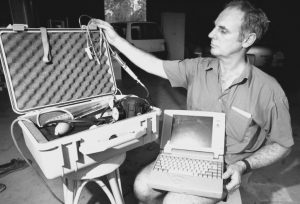
Celebrating 25 Years since the Rights of the Terminally Ill Act
Read More

Holocaust Survivor Zsuzsi Yardley dies in Switzerland
Read More

Australia Border Force Seize Peaceful Pill Handbook
Read More
March 6, 2022
Cancel Culture gets Uncancelled with Podcast Published
In January 2022 Exit Director Philip Nitschke was contacted by the ‘Let’s Get Psyched’ radio show and podcast series which is hosted by a group of psychiatrists/ psychologists at the University of California, Riverside with an invitation to take part in their program.
Let’s Get Psyched wrote:
‘The hosts at ‘Let’s Get Psyched’ would be honored to have you as an expert guest’
‘We would like to invite you to join us for a future recording!’
Philip accepted the kind invitation. A Zoom interview call was subsequently held and the Podcast recorded.
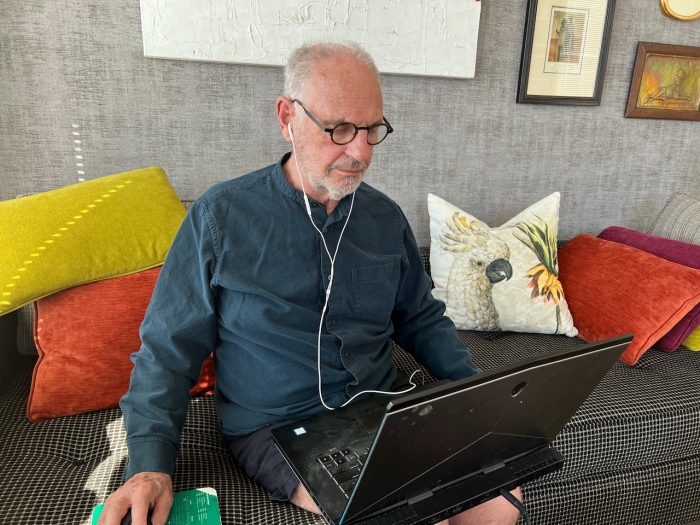
The show aired on the non-commercial college radio station KUCR 88.3FM shortly thereafter.
Around the same time, the team posted the podcast to their regular Podcast platforms (the same as used by Exit) including Anchor, Google, Apple etc.
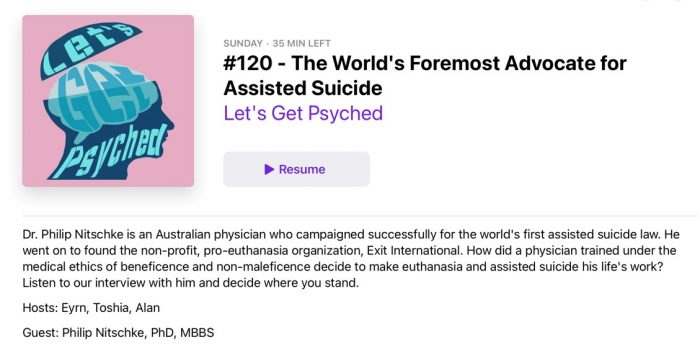
Philip tweeted the Podcast.
On 16 January 2022, he received the following kinda sweet ‘thank you’ note.

However, within days, the link to the Podcast with Philip’s interview stopped working.
https://podcasts.apple.com/us/podcast/lets-get-psyched/id1498987447
Indeed, on closer inspection, not only was the link faulty but the whole episode had mysteriously disappeared only to be replaced with an interview with a medical ethicist from the University of Nevada, Las Vegas.
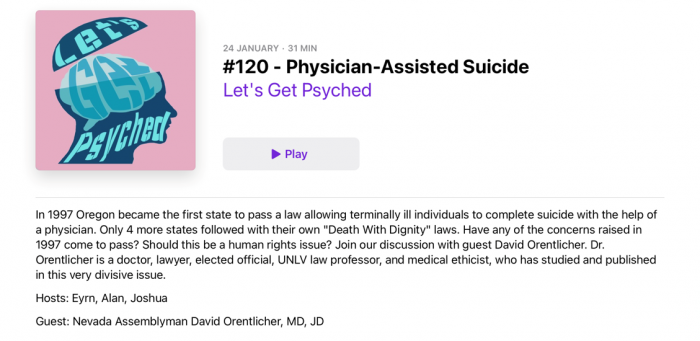
Initially, Exit thought the link that the team had posted an incorrect link on Twitter. An innocent enough mistake.
But then something more nefarious emerged.
When Philip queried the link with Let’s Get Psyched, he received the following reply.
Hello Philip,
Thank you for reaching out. We apologize for the delay in response. We really appreciated the conversation you had with us and your candor. We aired both episodes on our radio station KUCR and had the first episode up online for about a week, but over that time period, our group became divided about the episode. We also received listener feedback expressing concern about the episode. We decided to take it down while we try to come to an agreement. We wanted to resolve the disagreement amongst ourselves before proceeding further. We apologize for not notifying you about the change and the confusion that has caused.
Philip replied:
Hello Let’s Get Psyched team,
Thanks for the background
I have heard no more over the past 10 days
Does that mean attempts to ‘try to come to an agreement’, and ‘resolve the disagreement amongst yourselves’ have failed?
Could you please provide me with some detail It would be very much appreciated
regards
philip
The Team wrote again:
Dear Philip,
I hope you’ve been well.
I sincerely apologize for how long we are taking with this process. I did feel bad both this time and last time about how long we took to get in touch with you. We have been working on it consistently. We have never dealt with an issue like this before, so its a bit of a discovery process. Each matter has to be discussed and agreed upon between us before we advance it, but due to our disagreements on it, and wanting to make sure we do the right thing by you and by our audience, we have involved two bioethicist mentors, one of whom has not gotten back to us yet. We are a tiny operation consisting of residents and a psychologist, with no funding and our medical jobs to attend to first.
If you desire, I’d be happy to do a phone call with you to discuss your thoughts on the matter and your preferences as well as update you on the details of our concern.
We really enjoyed meeting with you and hearing your ideas, appreciate the time you took, and are hoping to have an end to this soon for all of our sake.
Warm Regards,
And then:
Dear Philip,
Thank you for your patience with us! I think it will make more sense once we share more about our conclusions and thought process. I forgot if i mentioned this, but it takes us a long time because coming to a consensus on things we all care about (like the topic of this episode) requires waiting for each of us to have the time to convene and complete our action items, etc. We like to process with various phone conversations and such, and are still sort of figuring out our own feelings as we go. Thought provoking stuff you brought us. We’ll be in touch.
Warm Regards,
The following day, Philip replied:
Thanks,
Appreciate the information.
No need to call – somewhat resigned… although surprised, I imagine my views on these issues would have been known and..
I’m a little unclear what it is about the discussion that requires the involvement of 2 bioethicists. In what capacity? but..
What we would really appreciate is a short statement re the basis of the decision so that we could provide it to our members who have been asking – possible?
regards
philip
12 days later, the team wrote:
Hi Philip,
We appreciate your patience as we continue to work on this. I have been emailing people multiple times a week since mid January in an effort to conclude this matter. We imagine you are pretty busy and would appreciate a quick resolution.
Thank you,
Cutting the Crap
At the time of publication – today 6 March 2022 – it is around 2 months since the Podcast was recorded.
This is more than enough time – surely – to sort out internal editorial censorship issues.
Philip Nitschke is a known quantity.
Why invite him to speak if his ideas are so dangerous that the podcast will not be able to be published?
Why waste his time?
If one were to accept that his views are dangerous (to some ears), where does this leave the First Amendment?
Why have Let’s Get Psyched turned to censorship?
What is it that their ‘bioethicist mentors’ could have brought to their decision-making process that they themselves were seemingly unable to agree on?
Is this conflict resolution between disagreeing psychiatrists?
Or is this children in the playground who need parental supervision about how to dig their way out of their self-made sandpit?
Or – more cynically – is the medical profession showing itself incapable and unwilling to countenance any point of view that challenges medical supremacy (and paternalism) in the assisted dying debate?
Either way, and with due respect to the team of psychiatrists, psychologist and registrars involved, this does not give one much faith (or hope) in the mental health profession.
On a brighter note, Exit preserved a copy of the Podcast interview and is pleased to publish it on the Exit website.
We apologize to those who reached out to Exit with complaints about the faulty link and the inconvenience of not being able to access the tweeted podcast.
But as you can see from the above, the matter was out of Exit’s hands.
Listen Now to the (Un)Cancelled edition of the Let’s Get Psyched Interview with Philip Nitschke.
And decide for yourselves just how dangerous the podcast really is …
February 6, 2022
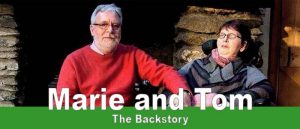
Marie Fleming & Exit International Ireland
The Backstory of Marie Fleming & Exit International Ireland
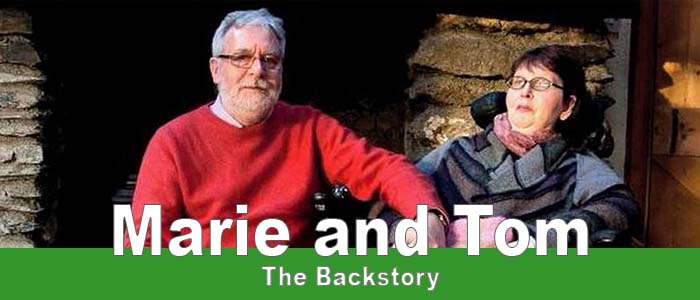
I first met Marie Flemming in 2011, a few years before she died.
Having only recently become acquainted with Tom Curran, Tom had invited us down to his stone cottage in countryside Arklow for an evening meal.
At that time Marie was still able to speak so the evening was warm, friendly and convivial. I will never forget the generosity of Tom in inviting us to his home (something that he has done for few others, in his efforts to guard Marie’s privacy). In addition to cooking a fantastic meal, he attended to Marie’s every need.
Some might say he was run ragged, but it was a marathon in the name of love.
And here we are 11 years later with an organisation in Ireland that is dedicated and works in the memory of Marie Fleming.
When Marie died at home in December 2013, she had advanced MS. Marie had lost nearly all bodily movement and certainly most of her dignity. This was not the life she wanted. Neither of them wanted the anxiety of not knowing if/ when Marie would wake up each morning choking on her own saliva because she could no longer clear her lungs or her throat.
The running joke in the household was Marie ‘not dying on your watch’. But it really wasn’t very funny. Rather, it was terrifying.
But Marie Fleming was so much more than her disease.
As she herself said:
All people see now is a woman in a wheelchair who can’t speak very well, who can’t move at all. But I lived. I loved. I am somebody.
Marie had been a University College Dublin lecturer who taught, amongst other things, gender studies. She had two children, her first Corinna was born in a mother and baby home and was almost removed from her at birth.
Marie’s fight to save her daughter is a book in its own right.
Born one of five children in Donegal to parents who endured an especially dysfunctional marriage, Marie’s mother left home abruptly when she was 14, running off with the local hotelier and Irish Senator, Paddy McGowan.
Marie’s father would later take a High Court case against McGowan alleging ‘criminal conversation’ with his wife and for enticing her away from ‘his house and society’. But this did not stop her mother leaving home, a total of five times.
Marie Fleming’s story – told in the book An Act of Love – is about so much more than taking a landmark case to the Irish High and Supreme Courts even though that is how she is perhaps now best known.
Marie Fleming & Exit International Ireland. See: www.exitinternational.ie
The Court Cases
As Marie Fleming’s MS got worse, so did the paralysis until she could no longer lift her arm, sit up unassisted or even talk. And she certainly couldn’t take her own life (put an end to her suffering).
If she had had another condition (eg. cancer) it would have been more likely that she would still have had movement and she could have lawfully taken her own life as suicide is no longer a crime in the Irish Republic.
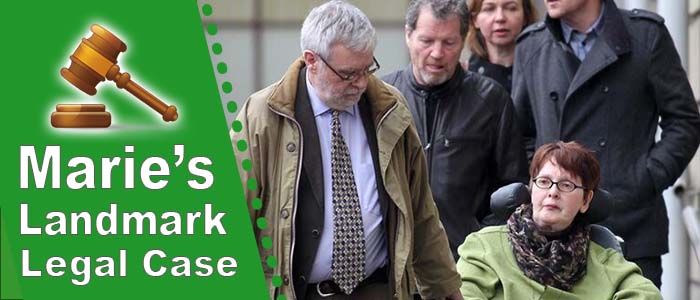
Marie’s initial case concerned a request for a declaration and orders that because she was paralysed from the MS, she needed help to die. Marie argued that she was discriminated against as a result of her illness. As Tom was willing to help her die it should have been QED.
Marie’s lawyers argued that the ban on assisted suicide was unconstitutional and incompatible with her rights under the European Convention on Human Rights (ECHR).
Marie also sought an order directing the Office of the Director of Public Prosecutions (DPP) about the issuance of guidelines (along the same lines as the Starmer guidelines in the UK) that would force the State to consider certain factors in deciding whether or not to prosecute an person for assisting or aiding another to end their life.
However the court disagreed.
So Marie appealed to the Supreme Court.
Again the Court disagreed with Marie Fleming & Exit International Ireland.
Chief Justice Mrs Justice Susan Denham, concluded that the right to life does not import a right to die and that there is no express right in the Irish Constitution to commit suicide.
Judge Denham continued that there is no constitutional right to commit suicide or to arrange for the termination of one’s life.
Judge Denham added, however, that there was nothing in the judgment to prevent the Government from introducing legislation in the future to deal with cases such as Ms Fleming’s.
Current Legislative Moves in Ireland
Ever since 2013, Exit International Ireland director, Tom Curran, has been lobbying for a change in the law so as no other people need go through what he and Marie went through.
As Tom himself has said:
‘law reform is a long and hard road but we must not give up. And we must not settle for the narrowest of laws that only help the terminally ill. This would be a mistake. Let us look to the Swiss model of assisted suicide’.
Since 1942, anyone can help anyone else to die in Switzerland as long as their motives are altruistic, and as long as the person receiving the help has mental capacity and can do the action themselves.
(In Marie’s case this might have meant administering lethal drugs via a cannula that allowed an eye-blink for activation or the new 3D-printed Sarco which is still in production).
The point is that Marie Fleming started the right to die movement in Ireland. It is only proper (and logical) that people like her would be able to be assisted by any change in the law.
2020
On 15 September 2020, TD Gino Kelly (People before Profit) introduced a private member’s bill to the Irish Dáil. By 7 October the bill passed its 2nd phase with majority support (81 to 71).
The Bill was intended to legalise Voluntary Assisted Dying (VAD) only for the terminally ill.
Despite receiving broad public support, the joint Committee on Justice did proceed (due to alleged insufficient safeguards for the elderly and vulnerable; concerns highlighted in some of the submissions considered).
2021
Almost a year later in July 2021, the Justice Committee stated that the Voluntary Assisted Dying Bill should be examined thoroughly by a a Special Committee. Some say this move is nothing but a stop-gap measure, aimed at buying time and doing nothing.
As of 2022, the Special Committee is yet to be established by the Oireachtas Business Committee. Should it be established it will be a cross-party committee comprised of 12 TD’s, representing all the parties.
It is interesting that in December 2021, the Irish Government announced a new €10 million in funding for palliative care services.
Call me cynical, but perhaps this was a smart move by the Government to rule out the old argument that we don’t need choice at the end of life, only better funded palliative care.
2022
In the coming months Exit will be holding a free public meeting at which we review the global state of play of right to die laws and explain why the Swiss do it better and why, in the name of Marie Fleming and countless others, Ireland is best placed adopt the Swiss legal model.
In 2023, Exit shall convene a major, international conference on the right to die.

Exit Conference in 2023
Exit International is currently planning for a major international right to die conference to be held in Dublin in May-June 2023.
To register your interest in any/ all Exit Ireland activities, you are invited to subscribe to our free Email List now.
December 12, 2021
Sarco goes Viral & the Backstory
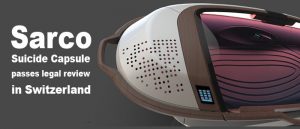
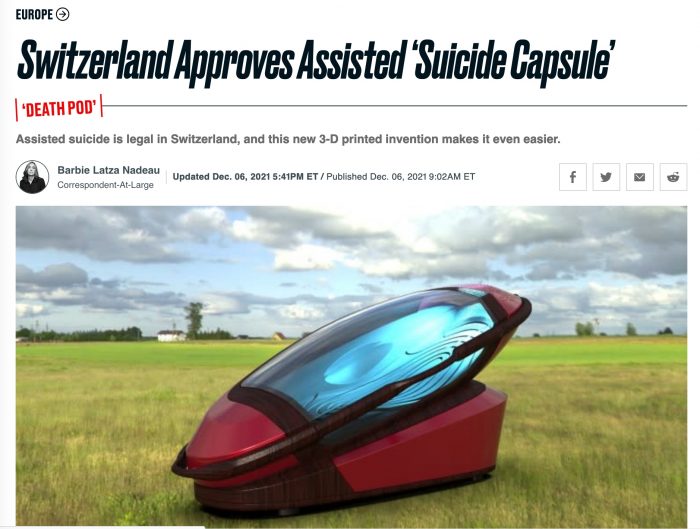
Sarco goes Viral & the Backstory is a behind-the-scenes look at how the word Switzerland started trending globally on social media because of a story about the Sarco Assisted Suicide Capsule (as it has now become known).
NOTE – The February 2022 Update to the Peaceful Pill eHanbook features a new, revised chapter on the Sarco.
Background
Over the years, SwissInfo have covered a range of Exit stories.
Until this week, their most recent piece about Exit was a profile piece on Exit Director, Tom Curran titled: ‘The Making of a Right-to-Die Campaigner’ (19 Nov 2019).
On 16 August 2021, SwissInfo again made contact with Exit, and conducted a short interview by phone with Philip about the progress of Sarco project.
This interview would not be published until almost four months later on 11 December.
SwissInfo journalist, Clare O’Dea, would later tell Exit that she had no idea about why the interview did not run back in August. Nor does Exit (of course).
But run the story did last week. Piquing the public imagination.
More than 1.5 million Google hits now appear for the search terms ‘Sarco Switzerland’.
According to Swiss media, the word Switzerland began trending on social media in Russia due to the SwissInfo Sarco story.
Changing Headlines
While the initial headline for the SwissInfo article on Sarco was ‘Sarco Suicide Capsule ‘passes legal review’ in Switzerland’.
This headline would later be changed to ‘hopes to enter Switzerland’. Exit is not aware why the headline was changed or who instigated the change.
The new bit of news in the article, however, was that Exit had, indeed, commissioned a legal review concerning the possible use of Sarco in Switzerland, and the result of the report by Professor Daniel Hurlimann was that, as far as his learned opinion was concerned, there are no legal or regulatory impediments.
This report remains commercial in confidence and will not be made public by Exit.
However, Professor Hurlimann has been prepared to answer media questions about his opinion.
Going Viral
As with a lot things online, the truth can easily get lost.
In this week’s stories on Sarco, the relatively innocent SwissInfo headline of ‘passes legal review’ morphed into something else entirely.
With hours, the Sarco story was reported as:
- approved by authorities in Switzerland (Futurism)
- ‘Dr Death’ campaigner targets 30-second suicide pod at Switzerland (The Times)
- approved for use in Switzerland (The Hill)
- Switzerland approves assisted suicide capsule (Daily Beast)
- Cleared for Use (Gizmodo)
- Switzerland legalizes Suicide Machine (India Times).
- Controversial suicide pod to be rolled out in Switzerland (Wales Online)
- Company offers assisted suicide pod in Switzerland (USA Today)
- Death Machine gets legal clearance (The Week)
- Switzerland’s assisted dying capsule machine approved for production (News.com.au)
- Switzerland Legalises Sarco Pod (Manufactur3D)
- Switzerland Approves a Device for ‘Quick and Painless’ Assisted Suicide (The Swaddle)
- Suicide machine death without pain in 1 minute in Switzerland, legal approval for death (News Track Live)
Even the BBC got their headline confused.
An initial article by their tech reporter, Jane Wakefield, stated ‘Maker of Suicide Pod Plans to Sell it in Switzerland’.
This was soon changed to ‘Plans to Launch it in Switzerland’.
If the BBC can get it so wrong, it is surely not surprising that others followed suit.
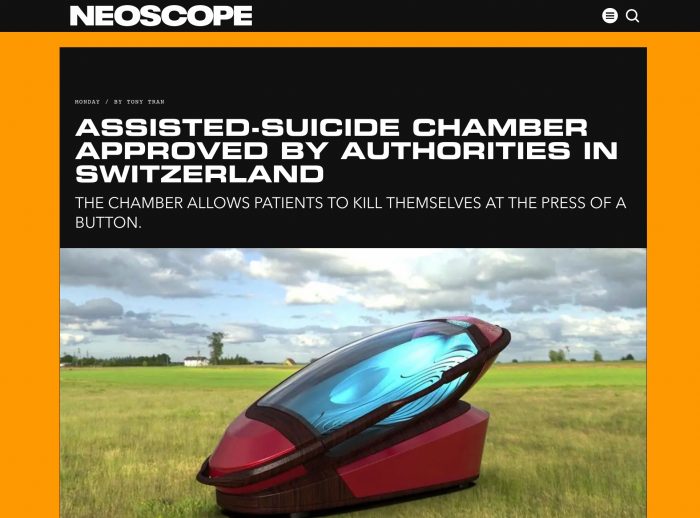
Of the more serious media, who took the time to listen and ask questions were Euronews and The Washington Post.
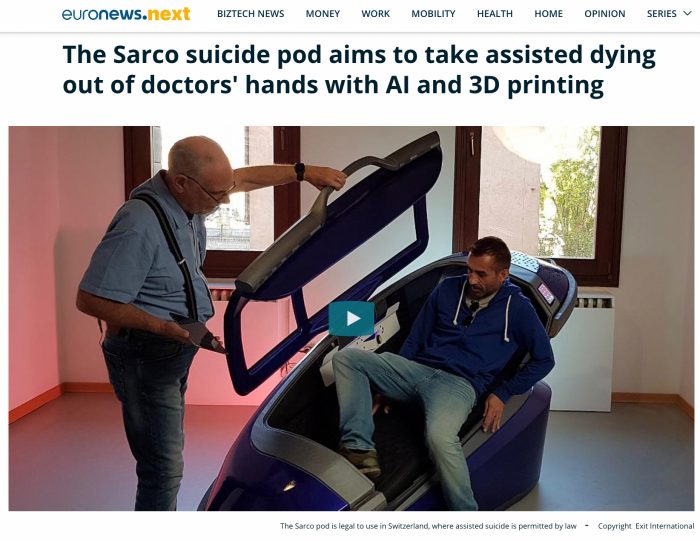
The latter headlined their coverage of Sarco as ‘Sarco, a machine for suicide, will soon be tested in Switzerland’ while Euronews wrote: ‘The Sarco suicide pod aims to take assisted dying out of doctors’ hands with AI and 3D printing‘.
The Medical Framing of the Right to Die Debate
The confusion over the status quo of the possible use of Sarco in Switzerland is perhaps best summed up in the email correspondence between a journalist for The World program on American Public Radio and Exit.
The journalist wrote:
‘My editors decided to hold off on this story until I can speak to someone on the Swiss medical review board. Do you have any contact information for the body that authorized the device?
I’m seeing an organization called Swiss Medical Board, though they are shutting down at the end of the month.
I also saw Swiss Medic, though on their website it says that medical devices do not undergo an official authorization procedure, so I’m a bit confused. Can you help point me in the right direction?’
Exit replied:
It is good you are holding off because there appears some fundamental misunderstandings. To clarify:
The point of taking Sarco to Switzerland is the first step in de-medicalising the dying process.
In the Netherlands you may be aware of the ‘tired of life’ debate and the bill currently before the Dutch parliament which aims to provide all elderly people of sound mind the right to ask for assistance to die. Professor David Goodall was a good example of this.
(A demecialised law also allows couples to go together, something not possible under a medical assisted dying law).
This repositions the good death as a universal human right instead of a medical privilege for the very sick.
Swiss law is universal in its construction, in contrast to Californian law for example, as it does not require a person to be terminally ill, or ill at all in order to get an assisted suicide.
Swiss law is based on the Swiss Criminal Code which states that anyone can help someone else to die as long as their motives are altruistic.
Case law has added 2 further requirements that the person must do the action themselves and they must have mental capacity.
The wide-ranging review that Exit commissioned has nothing to do with any Swiss medical board or doctors registration body.
In Swiss law, there is no requirement for doctors to be involved in the dying process.
The review was conducted by Professor Daniel Huerlimann, then of the Research Centre for Information Law at the University of St Gallen.
Funnily enough, one of the questions that was covered in the review was, is Sarco a medical device and, if yes, what type or regulations would it be subject to?
While Exit is not prepared to release the report publicly, the professor is prepared to be interviewed to answer questions.
I’m not sure if you have looked at sarco.design but this may help.
There is a fundamental shift underfoot from the medical aid in dying laws of your country towards the situation in Switzerland (and more recently in Germany and Austria as affirmed in 2020 constitutional court decisions).
There is significant information about the above on the Exit website, if you use the search box.
I hope this helps,
Kind regards
Exit
Confused & Confusing Assumptions
The automatic assumption of the journalist quoted above that the Sarco must have been approved by a medical body of some sort shows how the debate over assisted dying/ assisted suicide has been medicalised to the point where the Swiss legal model of de-medicalised assisted dying is simply unfathomable.
This is a pity because it means that advocates for those who fall outside the strict requirements of medical aid in dying laws in most, but not all countries, must undertake Assisted Dying Law 101 with journalists before discussion can be entered into.
Advocates such as Exit must explain that while there is voluntary euthanasia/ assisted dying for people who are seriously ill (and normally about to die within 6 months from their terminal illness), there are many more elderly people who want to know that they have the choice to go if their quality of life deteriorates (and they are not terminally ill).
Old age is rarely a lot of fun from a physical point of view.
The irreversible nature of the ageing process demands that a ‘good death’ be within reach of everyone who wants it as they reach the latter part of the lifecourse.
In the Netherlands, much less explanation is needed as the so-called ‘completed life’ debate is well advanced and currently before the Dutch parliament.
If the completed life bill is passed, all elderly Dutch people of sound mind will be able to request assistance to die, regardless of their state of health.
Illness will be only one of the criteria allowed by the state for a person to have a good death.
Old age will be the other criteria.
Conclusion
The end of life rights debate is not straight-forward, especially when a new technology such as Sarco is put into the mix of human rights, medical profession dominance, personal autonomy and so on.
This week was not the first time that the Sarco has been reported on.
When it was first unveiled in April 2018 at the Amsterdam Funeral Fair it attracted similar controversy.
No doubt the same will apply when it ultimately comes to be used, although at that time, no media will be present.
To stay abreast of developments about Sarco, please join the free Exit Email List.
Swiss Info is a subsidiary of the Swiss Broadcasting Corporation that operates a multi-language online news platform out of Zurich.
October 31, 2021
Fudging the Facts in the Azide Wars
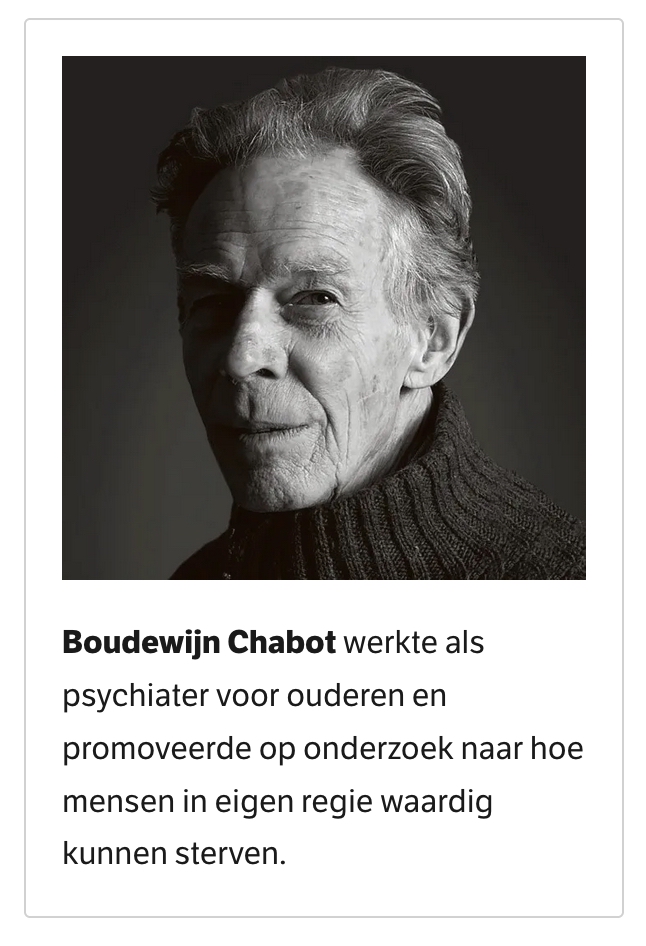
This week in Fudging the Facts in the Azide Wars, my old colleague, psychiatrist Boudewijn Chabot wrote a prominent opinion piece in the Dutch newspaper NRC called ‘I can’t warn enough about Middel X’.
Normally, I would welcome an opinion from a fellow activist, but not this week.
Chabot’s column has sought to rewrite a history: a challenging and important political history that is being played out as we speak, here in Amsterdam.
Let me preface this Blog by saying that, in my opinion, Holland has the most mature right to die debate of any country, anywhere.
In contrast to the comments this week by Australian Education Minister Alan Tudge that my country of birth is the ‘most free, most tolerant and most egalitarian country in all of human history’ (a point of view I beg to differ with – why would Australia then be the only country to ban The Peaceful Pill Handbook?), it is the Netherlands that as a unique ability to take on board and tolerate all manner of points of view on myriad topics.
This tolerance is normally achieved without inviting open warfare in the public domain.
However, in his possible desperation to be relevant to the debate, Boudewijn Chabot has not only fired a salvo over the bow of the group Cooperation Last Will (CLW), he has attempted to sink the organisation outright.
In doing so, he has cut corners, embellished the truth and left the debate and its stakeholders poorer in the process.
Let us examine the facts.
Chabot writes:
Last summer I saw on a video how a couple took the deadly ‘drug X’ and died. They said nothing to each other, did not touch. I heard them groan on the bed, until after an hour it fell silent. This was lonely dying at its best, just as lonely as hanging yourself, only it took much longer.
Correction: the video I showed Boudewijn during the 2021 European summer was that of an Australian couple taking sodium nitrite (not azide) to die together. Chabot knew this. He also knew that the death took 25 minutes, and not more than one hour.
In watching this recording, Chabot and I saw a death that was peaceful and dignified by an elderly couple who wanted to go together.
What’s not to like?
If Chabot is whitewashing the truth on a nitrite death video to suit his own agenda, what else in his column can or should be believed?
In his column, Chabot attempts to paint CLW as reckless, dishonest and detrimental to the DIY end of life rights movement.
He makes a big note that he has been ‘in the game’ a lot longer than CLW but this does not give Chabot a monopoly of moving the debate forward or challenging the political establishment.
In The Peaceful Pill eHandbook we state, in summary, about Middel X:
The reliability of a death from ingestion of sodium azide make this salt an effective option. However, questions remain about the time taken to loss of consciousness. The possibility of unpleasant symptoms remains.
The lack of any antidote is seen by many as an important positive factor, especially if there is the prospect of intervention by the emergency services.
Problems associated with its storage, safe disposal, and the risk it poses to others after death may also serve to limit its usefulness.
That said, sodium azide is an important, available substance that provides a lawful, end of life option for those who have no access to the barbiturate, Nembutal.
Sure, CLW may at times have seemed overly enthusiastic about Azide, but for the above reasons they are arguably justified. In the PPeH we rate Azide just below Nitrite and well above that other lethal inorganic salt, Cyanide.
Of course, Middel X is not Nembutal but then CLW never claimed it was.
But it is a reliable, lawful alternative. CLW do not deserve this public vilification for taking an activist approach.
What is it they say? He who does nothing breaks nothing? Listen up Dr Chabot.
Backstory
The Azide Wars first erupted 2 years ago when the journal of the Dutch Medical Association, NTvG, published several articles attacking what was described in the editorial as ‘the ideology of suicide’. This the topic of a former Peaceful Pill Blog.
In the lead article ‘The Rise and Fall of Agent X’, Chabot’s then coauthor of his book Uitweg, Stella Braam, named CLW as ‘enthusiastic amateurs, blinded by their enthusiasm and pressured by their supporters’.
From the totality of the articles published in this infamous March 2019 edition of NTvG, the medical establishment (with whom Chabot is aligned) was revealed as deeply hostile towards any group advocating the right to have non-medical control over one’s death.
So Chabot’s personal conclusion that death will not come quickly in 20-30 percent of Azide cases is neither here nor then because it is the agenda behind this opinion that is driving this partial analysis.
If Chabot’s data analysis were to be accepted (which it is not), this does not make a joke of the claim that Sodium Azide can provide a peaceful death.
The data on the nature a death from Sodium Azide is relatively young. Yes, there is little hard science at the moment but watch this space because as time goes by there will be.
Any alleged sloppiness in the Sodium Azide data is more down to the need for that data to be gathered clandestinely. Being present at a person’s death is still a legal grey area. Utmost caution is required.
That CLW has been able to collate data of the known deaths among their members is something they should be commended for.
But this is not good enough for Boudewijn who, it seems, has assumed the mantel of Azide Expert. ‘I cannot warn enough about drug X as a suicide drug’.
As Chabot’s opinion piece nears its climax, his arguments sound increasingly hysterical.
There is CLW Chairman Jos Van Wijk who is accused of exploiting the 26,000 odd members of CLW at a time when they are ‘in an unstable phase of life’.
Call the elderly membership of CLW many things, but patronise them at your peril!
Van Wijk is also, apparently, guilty of not showing compassion to people who are less strong in life than he is.
While I’m not the first one to say that Jos has a penchant for bluster from time to time (he is an angry Dutch Baby Boomer after all), his approach, in my opinion, has been largely successful.
Unlike NVVE, a group which personifies the Dutch euthanasia establishment, CLW have single-handedly kept the issue of older people’s right to self-determination on the Dutch political agenda.
And then there is Chabot’s grasping of as many sordid examples of unsuitable deaths as he can, including that of Dutch teenager Ximena Knoll.
Ximena suicided using sodium nitrite around the same time that CLW launched their Middel X campaign. While her premature death is indeed tragic, CLW were hardly to blame.
As with other cases of teenage suicide that have made it into the mainstream media, it is the parents who took to the warpath looking for someone/ something to blame: rather than looking closer to home to determine how such a tragedy could have been prevented.
Chabot concludes his column with what can only be described as an attempt of the high moral ground.
In his book, he writes, ‘I was never secretive about the name of lethal substances and I did not withhold any toxicological information. You must be able to base the one-off decision on how to end your life on public and complete data’.
Sorry, did I hear him right?
My good colleague fudges the truth and the single inorganic salt death that he has been able to witness and then tries to argue for disclosure of toxicological information and a need for ‘public and complete data’.
The pot has called the kettle black
But Chabot’s final cudgel concerns the relatively few deaths that CLW have recorded among their members in the five years since their campaign as proof that the membership of CLW has no confidence in its leadership.
Only 30 deaths from a membership of 26,000+
It is on this point that the greatest disservice is done.
If there is one thing that everyone in the right to die movement can agree on it is that everyone wants choice.
Most of us will never use that choice but we will all draw comfort from knowing that we will have control over when and how our days will end.
This is the argument that underwrites all our efforts at Exit.
Being a member of Exit and reading the Peaceful Pill Handbook can make you live a longer and happier life.
Why?
Because you are back in control and you can get on with living. Rather than worrying about how you might die.
Chabot can and does know better.
He should not go unchallenged in this prominent column in one of the Netherland’s most respected broadsheets.
Philip Nitschke
Amsterdam, 31 October 2021
Exit