Peaceful Pill Blog

Cancel Culture gets Uncancelled with Podcast Published
Read More
Marie Fleming & Exit International Ireland
Read More

Sarco goes Viral & the Backstory
Read More

Fudging the Facts in the Azide Wars
Read More

Ensuring Northern Territory Rights Bill 2021
Read More

The Azide Wars
Read More

Suicide Related Materials Offences Act
Read More

Celebrating 25 Years since the Rights of the Terminally Ill Act
Read More

Holocaust Survivor Zsuzsi Yardley dies in Switzerland
Read More

Australia Border Force Seize Peaceful Pill Handbook
Read More
November 3, 2016
Should the Dutch extend euthanasia to the ‘well’ elderly?
Extending assistance to die to the so-called ‘well elderly’ is a topic that has long been of interest to Exit.
Indeed, it is one of the reasons that the Peaceful Pill Handbook is published.
In recognising ‘euthanasia’ – a good death – as a civil right, it is only logical that those with a terminal illness or unbearable suffering should not be the only ones to be able to die well.
A peaceful death is everybody’s right.
In stating that the Dutch law will be changed, the Dutch government is acknowledging this sentiment fully.
In Holland, this phenomenon is referred to as ‘completed life’.
That is, older people who feel they have lived a good and long life, are going to have the option to go at a time of their choosing.
While the Dutch are stopping short of legalizing the possession of Nembutal by the elderly, the model they are proposing is an interesting mix of the medical model (approval from doctors is needed) and the civil rights model (accessible to everyone).
The new extension to the Dutch euthanasia laws will be limited to the elderly. So this is not allowing teenagers or those in mid life to opt out.
Rather it is a typically pragmatic Dutch way of alleviating the cruelty that can be associated with forcing someone to live on past their chosen time.
Philip Nitschke’s mother Gwen was one such person who would have benefited greatly from a law like this. That is, if she had been Dutch (which she wasn’t).
Gwen Nitschke spent her last 6 years in an Australian nursing home.
And she hated it.
Even if assisted dying had been legal in Australia (which it isn’t), Gwen would never have qualified to get help to die.
Gwen’s problem was that she was not sick. She was just old.
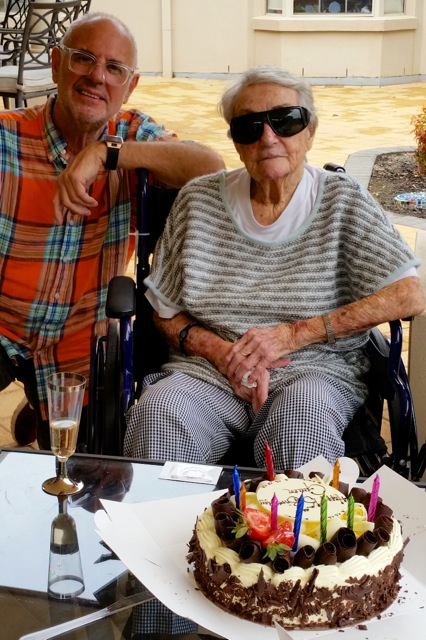
Philip with Gwen on her 95th Birthday
Her friends had all died. Her looks and her mobility had gone. But every day she was forced to go on.
What was the purpose of living she would often ask?
And before you ask, no she was not depressed.
She simply thought she had completed her life and now was the time to go.
Last December, Gwen finally passed away after receiving terminal sedation and being in a coma for 3 days.
Hardly the dignified end that she wanted.
RIP Gwen Nitschke
Fiona Stewart
Citation Requirements
To cite this article, please include reference to the author, the title, the date of publication & the citation link below:
September 25, 2016
Why the Belgians have it right
It will be twenty years ago this week since the Northern Territory passed the world’s first law on voluntary euthanasia.
The Rights of the Terminally Ill Act (ROTI) was a carefully-drafted piece of legislation that allowed a terminally ill person of sound mind to ask a doctor for help to die. The law expressly excluded children.
While the ROTI law only lasted nine months until it was overturned by a conscience vote in Federal Parliament, its legacy lives on in today’s debate about right to die legislation.
The flurry of enthusiasm in recent days by Victorian politicians means that a voluntary euthanasia law in this state is a sure thing. It is only a matter of time.
With this in mind, and given the news from Belgium of the euthanasia death of a terminally-ill 17-year-old – ie a minor/ child, it seems a good time to be asking ourselves what type of law we want Spring St to pass.
In proposing the NT law back in 1995, then Chief Minister Marshall Perron said that he did not want a law with safeguards so strict that the process of qualifying was a tortuous one.
Sadly, Perron’s fears were realised. At least according to Dr Philip Nitschke. Philip speaks often of the hoops that his four dying patients had to jump through in the process of qualifying to use the law. He says the ordeal almost killed them.
Do we want the same for Victoria?
Do we want to force dying people to spend their final days, using the little strength they have left dealing with red tape?
Where does the balance lie? Can we do better?
It was not only safeguard overload that marked the NT’s attempt at a law, the ROTI Act also excluded young people. Back then, the plight of teenagers was firmly in the ‘too hard’ basket.
This is despite the fact that young people get terminal diseases like cancer, and despite the fact that palliative care can often only go so far in relieving the awful symptoms that serious illness can bring.
It is not only Woody Allen who fears the way he will die, rather than death itself, the academic literature says the same thing.
The news of the recent euthanasia of the teenager in Belgium has re-ignited the right to die debate globally.
The Belgium Federal Euthanasia Commission has been reported saying that the terminally ill young person asked for euthanasia because they were in ‘unbearable physical pain’.
What is there to argue about.
Do we – as a society – insist the young person must suffer on, simply because they are under 18 years of age?
Or do we do the right thing and allow them some relief in their final weeks, days or hours?
When confronted with the facts of the situation in Belgium, I would argue this is a no brainer.
We wouldn’t torture our pets. We should not torture our terminally ill children.
When it comes to kids and euthanasia, the largesse of Belgium and Holland’s laws should not be underestimated.
These countries have not shied away from this pointy end of the right to die debate. Their humanity should be celebrated. And let’s not stop here.
What about the psychiatrically ill? This was another group excluded by the NT law.
Yet these people too can request euthanasia in Belgium and Holland.
Indeed, at the euthanasia conference that I am convening this week at the State Library, controversial Belgium psychiatrist Dr Lieve Thienpont is one of the keynote speakers.
Dr Thienpont’s work in Flanders in Belgium is almost exclusively in the area of euthanasia for the psychiatrically ill.
In Melbourne she will be talking about euthanasia for children, non-terminally ill older people (those who say they have had a good innings but now is the time to go) and the mentally ill.
While so-called pro-lifers will no doubt picket her appearance, I have found Lieve to be a calm and gentle woman who has been prepared to stick her neck out on behalf of the most vulnerable in our community.
Those who other euthanasia laws turn their back on.
In this regard, Dr Thienpont has battled it out amidst the sensationalist headlines.
Even if you do not agree with euthanasia, the insights which someone of her standing and vast experience deserve a fair hearing before we allow debate to turn to arguments of slippery slopes and eugenics.
For the likes of Dr Thienpont, suffering is suffering regardless of age and irrespective of whether one has an un-treatable physical or mental illness.
If treatment, let alone cure, is not an option then why should we insist such people live on?
These are the difficult, but not iresolvable, questions that the Victorian Parliament is going to have to face if they are to bring in euthanasia legislation.
There are plenty of nay-sayers who will tell them it’s all too hard and to leave well alone. But the Belgium experience suggests that euthanasia legislation can be broad and it can work well if preventing needless suffering is its aim.
Fiona Stewart, PhD LLB
Citation Requirements
To cite this article, please include reference to the author, the title, the date of publication & the citation link below:
July 31, 2016
Why Legalized Testing of Nembutal is Common Sense
In mid July at the Secret Garden Party Festival in Cambridgeshire in the UK, The Loop alcohol and drug testing service achieved the impossible.
They conducted police-approved, lawful drug testing for party-goers.
Politics.co.uk writes that a 10m sq patch of lawn became Ground Zero for those wanting their party drugs tested.
This is how it worked.
Party-goers would bring a sample of their drugs in for testing.
Those drugs were put through a rigorous three-phase testing process where they were ‘tested for content, purity and strength by a team of chemists without any police interference.’
The testing took around 15 minutes.
‘When those using the service came back to collect their results, they were given individually tailored, free and confidential advice by experienced drugs workers.’
‘This was not ‘drug checking’ to ensure safer consumption, but harm minimisation.’
‘And yes, it was legal.’
‘No drugs were returned to users and all drugs were destroyed in the testing process, with police collecting any remnants.’
The parallels with Nembutal testing for the elderly are clear.
Bring in a sample of what you have?
The sample will not be returned to you.
Post-analysis you will know if you have a lethal drug or not.
At this point you will be subject to counseling.
Nothing patronising, just common sense.
Do you have the mental capacity to make decisions about your life and death?
Do you realise what would happen if you were to take your drug?
Counseling that ensures that you have the ability to make your own informed decisions and you understand the consequences of them.
Knowing you have the ‘real thing’, you could go home, lock it safely away secure in the knowledge that your insurance for the future is assured, while hoping all the while you’ll never need it.
If you have been cheated (perhaps by an unscrupulous online Nembutal scammer), you can flush your product away, grateful that you may have just been saved from a fate worse than death.
Think about it.
Fiona Stewart, PhD LLB
Citation Requirements
To cite this article, please include reference to the author, the title, the date of publication & the citation link below:
July 14, 2016
Why Theresa May is no Feminist
I must admit, while not a conservative voter, last week I started to get a bit sucked in!
Last week, there was Theresa May, Britain’s would-be next (and now new) Prime Minister wearing purple.
While I’m yet to notice Hillary in the color of feminism (and dignity), I convinced myself that May’s choice of frock color was no accident.
And then there was that photo of her in the black tshirt, with white writing stating ‘This is what a feminist looks like’.
Good on her I thought!
I’ve always liked the sentiment as I thought smugly to myself, there’s the proof.
But one look at May’s voting pattern on the fundamentals of bodily determination – read the fundamental human rights of abortion and euthanasia – and she is as anti-choice and as anti-feminist as the next ‘pro-lifer’.
For instance, in regard to Britain’s last right to die bill known as the Marris Assisted Dying Bill No 2, May was one of the 74% of MPs to vote against the bill.
Point is she didn’t have to nail her colors to the post quite so blatantly, she choose to do so.
Especially not when David Cameron, Tim Farron of the Lib Dems, Angus Robertson (SNP at Westminster) and Jeremy Corbyn (one day before he became Labour leader) did not vote at all.
Only Ed Miliband (then Labour Leader) supported the bill, and presumably a person’s right to choose when and how they die.
And then there is May’s infamous 2008 parliamentary vote on a bill that sought to decrease the period when a woman could access an abortion from 24 weeks to 20 weeks. This occurred in the face of medical/ scientific opinion to the contrary.
Clearly, if we are talking about the weeks of gestation we are not talking about women’s rights. Already the discourse is that of the pro-life, anti-choice anti-woman polemicists who seem to think that the woman carrying a foetus is nothing more than a vessel with no voice and no say over what happens to her body, to her self.
I wish I could be optimistic about Mrs May. But I’m not.
The fact that the UK has voted on 12 separate assisted dying bills over a space of 11 years and that the most recent attempt in September 2015 was defeated so soundly (74% against), begs the question of whether Westminster will ever grow up enough to pass civilized laws when it comes to the end of life.
With Theresa May in charge one thing is for sure. This won’t be any time soon.
Fiona Stewart, PhD LLB
Citation Requirements
To cite this article, please include reference to the author, the title, the date of publication & the citation link below:
Exit